Raising Expat Kids in Moscow: Learning to Let Go
When you move countries with children, you don't just worry about whether you'll adapt. You worry about them. An honest account of Moscow kindergarten, from the food to the fees to the letting go.
Julia Falfouchinskaya · 2 October 2026 · 7 min read
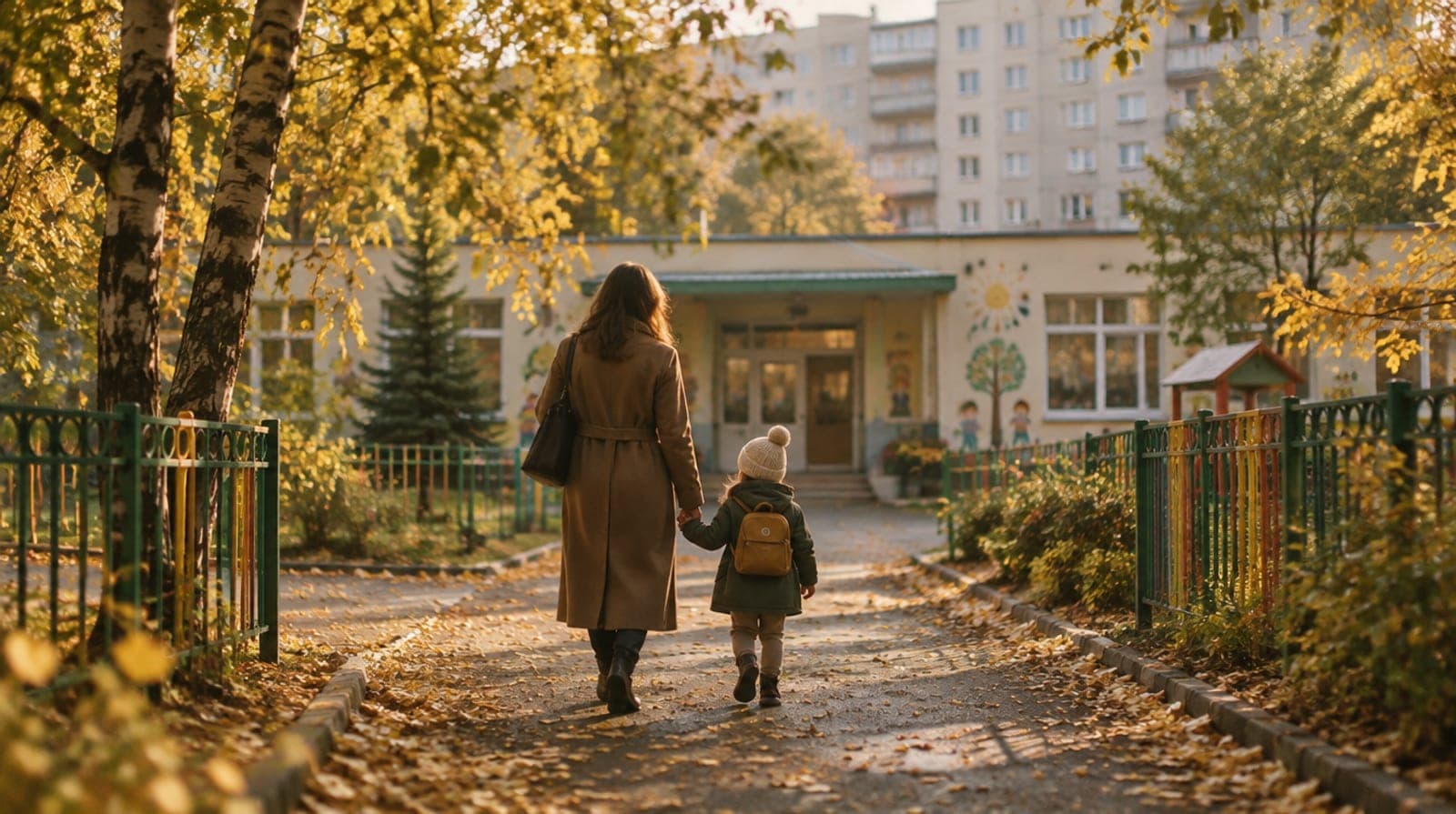
When you move countries with children, you don't just worry about whether you are going to adapt.
You worry about them.
When we moved to Moscow, our children were still quite young. They already spoke Russian, which removed one big concern, but my biggest worry was kindergarten.
Where would they go?
Would they be happy?
Would the teachers genuinely care about them?
Would they make friends?
And perhaps the biggest question every parent asks themselves when making a major change:
Are we doing the right thing for our children?
Looking back now, I think we probably worried much more than they did.
Public or private?
One of our first decisions was whether to choose a private kindergarten or enter the Moscow public system.
Because we have residency in Moscow, we were fortunate to receive a place in the public system.
And there were quite a few things that surprised me.
The first was simply how much is available.
At our kindergarten, care is available five days a week from 7am until 7pm.
That doesn't mean your child needs to spend 12 hours there. In fact, when our children were adjusting, the recommendation was to start with a much shorter day — roughly 8:30am until 1pm.
At around 1pm, the children have their daytime sleep until approximately 3pm.
Once they're comfortable and adjusted, you can gradually extend their day. Eventually, if it suits your family, they can stay through their sleep, have afternoon tea and be collected later.
For a parent who needs to work long hours — particularly a single parent without much support — simply having that option available can make an enormous difference.
And then there's the food...
This was another surprise.
At our kindergarten, the children are fed throughout the day, with food freshly prepared for them.
Breakfast is around 8:30am and is a proper hot breakfast. It might be porridge or an omelette, accompanied by a sandwich and tea or another drink.
At around 10:30 or 11am, they have fruit and drinks.
Lunch comes at approximately 12:30 and normally includes soup followed by another hot meal — something like mashed potatoes and meatballs — plus a drink.
After their afternoon sleep, there's afternoon tea at around 3:30. That could be pancakes with tea, kefir or something similar.
And for children staying later, dinner is also available.
For our family, public kindergarten costs around ₽5,000 per child per month, including their regular meals.
Of course, fees, schedules and what's offered can differ between kindergartens and individual circumstances, so this is our experience rather than a universal price guide.
But coming from overseas, I found the entire system fascinating.
They're not just playing all day
I think sometimes we imagine kindergarten as somewhere children simply go to play while their parents are busy.
There's plenty of free play, of course.
But there's structure too.
Our children generally have two age-appropriate lessons in the morning. Depending on the day, that might include PE, music, maths, reading or painting.
Our kindergarten even has a heated swimming pool, where the children can have a roughly 40-minute session with a teacher as part of what's available to them.
Parents can also choose additional paid activities, such as karate or extra language lessons.
The children know that there is a time to play and a time to listen.
They're expected to participate, follow a routine and respect their teachers.
And I've noticed the difference.
They're learning.
They're developing.
And importantly, when I pick them up, they're happy.
Structure doesn't mean a lack of affection
It took a few months for our children to completely adjust.
They had never attended childcare or kindergarten before, so this wasn't just a new country or a new building. It was an entirely new experience for them.
Some teachers are stricter than others.
The children aren't necessarily going to be mollycoddled every moment of the day — and I've realised that's okay.
They're expected to listen when it's time to listen.
But something I've really appreciated is that structure and affection can exist together.
I've watched teachers comfort a child who is upset, pick them up, hug them and help them settle down. Appropriate physical affection isn't treated as something teachers need to be frightened of.
Many of the women caring for the children genuinely seem to love what they do.
For a young child spending hours away from Mum and Dad, that warmth matters.
They can become almost another maternal figure during the child's day.
The parents become part of it too
Something else I've noticed is how involved the parents are.
There is a real community around the children.
Parents organise things together, contribute when something is needed and regularly arrange gifts for the children and teachers around holidays and celebrations.
There are also expectations around the quality of additional lessons parents choose to pay for.
From my experience, teachers are held to a high standard. If parents are paying extra for a particular activity or lesson, they expect the children to actually learn and progress.
It's not simply about keeping them occupied.
Results matter.
Even being sick surprised me
Even the process when a child becomes sick was different from what I was accustomed to overseas.
In our experience, if one of our children is unwell, we take them to the children's clinic.
If the doctor determines that they're sick and shouldn't attend kindergarten for a certain period, that information is communicated through the system.
Those missed kindergarten days are then taken into account on our bill.
It's a relatively small thing, but when you're adjusting to life in another country, these are the little differences you start noticing.
What if my child doesn't speak Russian?
Our children already spoke Russian when we arrived, so naturally that made their transition easier.
But if you're planning to live here permanently and your young child speaks little or no Russian, I wouldn't automatically see that as a reason to avoid the public system.
In many ways, I think immersion can be one of the most effective ways for a young child to learn.
They're surrounded by Russian.
They play in Russian.
They hear instructions in Russian.
They make friends in Russian.
And if Moscow is going to become their home and they'll eventually continue into Russian schooling, they're not simply learning a language.
They're assimilating into the world they're actually going to grow up in.
Obviously every child is different, and parents know their own children best. For some families, a private or international environment may still be the better choice.
But I wouldn't underestimate how quickly young children can adapt.
I've certainly learned not to underestimate mine.
Maybe Mum needed to adjust too
Kindergarten has actually taught me something as well.
I've had to let go a little.
As parents, particularly when our children are young, it's very easy to feel like we have to provide absolutely everything they need.
But maybe we can't.
And maybe we're not supposed to.
I can't replicate a room full of children their own age.
I can't give them the experience of making their own friends without me standing beside them.
There's something different about listening to a teacher, learning from another adult, navigating little friendships and slowly discovering that they can do things without Mum and Dad.
My children make friends far more easily than I expected.
They listen to their teachers.
They respect what their teachers have to offer.
And they're becoming their own little people.
Perhaps one of the harder parts of raising children is recognising when they need you to hold their hand — and when they need you to loosen your grip on it.
We worry more than they do
If another parent was considering moving their family to Moscow and lying awake worrying about how their children would cope, I wouldn't tell them that every experience will be perfect.
Ours hasn't been.
Adjustment took time.
Different teachers have different personalities. Different children need different things. And something that works beautifully for one family might not suit another.
But that's okay.
You aren't signing away your ability to make decisions for your child.
If something doesn't feel right, you can change it.
Give it a chance. Trust your instincts and intuition.
Guide your children. Push them gently in the right direction. Be there when they genuinely need you.
But sometimes, let go a little too.
Because one of the biggest things I've learned since bringing our children to Moscow is that we parents often spend far more time worrying about whether our children will adapt than the children spend actually adapting.
Sometimes they're already making friends while we're still standing at the kindergarten door worrying about them.
Written by Julia Falfouchinskaya, Finance & Public-Facing Co-Host at Moscow Expat Events. Julia moved to Moscow with her husband and their two children. If you're newly arrived and finding your own feet, the upcoming events are here.
Keep reading

Making Friends in a Metropolis: Finding Your People in Moscow
Moving to Moscow later in life means arriving without a friendship group — and nobody warns you how quiet that gets once the children are settled. An honest account of making friends after thirty in a very big city.
23 September 2026 · 5 min read

How to Meet People in Moscow Without Awkward Networking
Business-card evenings are not the only option. A practical look at how smaller, hosted gatherings make meeting people in a big city feel normal.
7 September 2026 · 2 min read

Your First Winter in Moscow, Honestly
The cold is the manageable part. A frank guide to the first Moscow winter — light, layers, and keeping a social life alive from November to March.
8 September 2026 · 2 min read